

In my Digital Marketing class this week, we dedicated time delving into the world of search. We had been prompted for our final project to focus on a brand that we could benefit from a digital marketing campaign and we had picked Chewy, a major online pet retailer, as our brand of choice. For weeks we have been putting together our research to figure out their strategy gaps and identify a way in with their declining new customer base.
Now, there is a version of this campaign that never happened. One where we leaned into fun pet content, cute moments, and a social-first idea built around community and relatability. We thought it was a reasonable starting point – but then we ran the keyword data, and everything changed.
When we pulled search volume reports through Moz and SEMrush for Chewy.com, we were expecting to confirm what most people assume about the brand: that its search authority lives in product categories. Food, toys, litter, supplies, mainly transactional stuff. What we found instead was something considerably more interesting. The queries driving the highest indexed traffic were not product-led, but rather health-led. Pet owners were searching for things like heartworm prevention, flea medicine, specific prescription medications, and detailed questions about what foods are safe for their animals. These were not people in buy mode. They were people in worry mode. And this brand was already meeting them there in meaningful volume. This reoriented our entire campaign strategy. Not just the search channel, but all of it.
Where the Organic Opportunity Lives
Chewy owns PetMD, one of the most trusted pet health content destinations on the internet, which means it already has significant organic authority in exactly the health query space the data revealed. The opportunity is not to build something new. It is to connect what already exists. PetMD content ranking for queries like “cat sounds” or “dog breeds” or “heartworm medicine for dogs” is currently functioning as a separate ecosystem. The campaign strategy we developed pushes those pages into the Chewy brand system more intentionally, so that a pet parent who lands on a PetMD article about flea prevention sees Chewy as the natural next step, not a separate destination they might or might not find on their own.
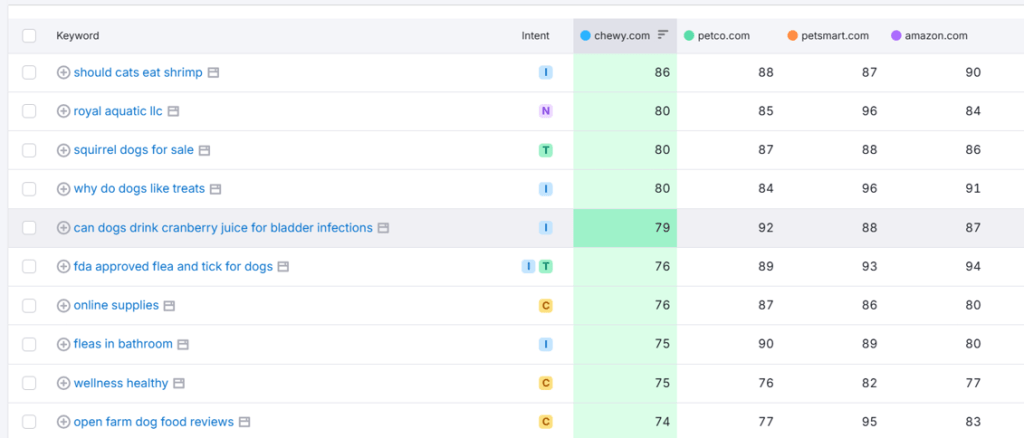
This is a genuinely defensible organic position. Competitors like Petco and PetSmart rank for many of the same product-related terms, but they are nowhere near Chewy’s authority on health content. The data showed Chewy holding top rankings on health queries where the competition either does not appear at all or falls well outside the top 10. It’s not a gap that Petco or PetSmart can close quickly, because content authority of that kind takes time to build.
The main focus of the SEO work becomes about deepening that content relevance to audiences. Publishing more health-first articles through PetMD, building internal linking structures that connect health content to relevant products and pharmacy pages, and optimizing for the kinds of informational queries that indicate a pet parent is in an early or anxious stage of their journey.
What makes this particularly compelling is where the organic journey can end up. Chewy’s acquisition of Modern Animal means that a pet parent who starts with a late-night search, lands on a PetMD article, and wants to take the next step now has somewhere to go that still lives within the Chewy ecosystem. That is not something Petco or PetSmart can offer. Their search presence may overlap on product terms, but neither has a direct path from health content to actual veterinary care. Chewy does.
How This Informs the Other Channels
The search data did not just tell us where to spend on search. It told us who our audience actually is and what they actually need, which changed how we approached every other part of the campaign. Social content that had been conceived as light and fun was reframed around health education and genuine pet care guidance, because that is what this audience is seeking when they sit down and start searching. Podcast and audio placements were oriented toward vet voices and health insights rather than product promotions, because the data suggested the audience responds to expertise before it responds to convenience. OOH and awareness media were designed to signal trust and healthcare credibility, not just brand recall.
Winning in the Age of AEO and GEO
The question of how to compete in search is increasingly not just a question about Google rankings. Answer Engine Optimization and Generative Engine Optimization represent a meaningful shift in how consumers find information, and for a brand whose competitive advantage is health content, this shift is arguably more important than it is for most.
When someone asks an AI assistant whether a particular medication is safe for their dog, or what the symptoms of a common illness look like, the response they get will be sourced from somewhere. Brands that have built deep, credible, well-structured health content are more likely to be that source. PetMD’s existing authority is an asset here, but only if the content is structured to be machine-readable, cited, and trustworthy enough to surface in AI-generated answers. That means investing in content that answers specific, conversational questions directly. It means schema markup that helps AI systems understand what a piece of content is about. It means building topical depth rather than surface-level coverage, so that across a range of related health questions, Chewy’s content ecosystem offers the most complete answer available.
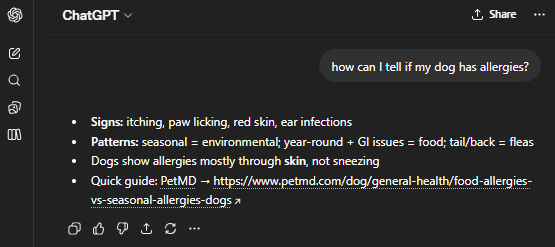
The honest conclusion here is that search and AI discovery are becoming the same thing. The pet parent who would have once typed a symptom into Google is increasingly asking ChatGPT, Perplexity, or a voice assistant instead. Winning in that environment requires the same foundation that good SEO always has: genuine expertise, well-organized content, and a clear point of view. The difference is that the stakes for being the trusted source are higher now, because an AI answer does not show ten results. It picks one, and it attributes it. The brand that has invested most seriously in health content authority is the brand most likely to be that answer, and Chewy’s existing infrastructure puts it closer to that position than most.
Search rarely gets treated as a strategic insight tool. More often it is handed off as a tactical execution, something to be optimized after the big idea is already in place. What this project reinforced is that the data search surfaces, if you look at it early and look at it honestly, can tell you something true about what your audience actually wants. In this case, it told us that Chewy, a brand widely perceived as a pet supply retailer, was actually already being trusted with something far more significant: the health and wellbeing of people’s animals. The campaign’s job became to close the gap between what Chewy already was in search and what the broader market still thought it was.



 intentionally integrated
Leave a comment